

PLANT TISSUES.
Types of Tissues.
Permanent tissues:
- A permanent tissue is a group of cells, which is derived from the meristematic tissues, but these cells have lost the power of division temporarily or permanently.
Note: The development process by which cells which have been derived from meristematic tissue, take up a permanent shape, size and function is called differentiation.
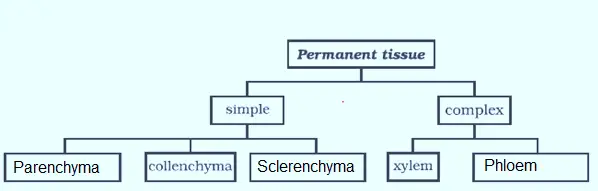
Permanent tissues are of two types: –
- simple permanent tissue and
- complex permanent tissue
Simple permanent tissues:
These tissues are composed of cells which are structurally and functionally similar. These tissues are of three types:
- parenchyma
- collenchymas and
- sclerenchyma
Parenchyma:

- Derived from Greek word “para= besides & enchein= to pour”.
- Parenchyma forms the bulk of plant body. It consists of thin walled living cells.
- The cells are isodiametric, i.e., equally expanded on all sides.
- The cell wall is thin and encloses a dense cytoplasm which contains a small nucleus and a large central vacuole.
- The intercellular spaces are abundant.
- The parenchyma is present in all the organs of the plants, i.e., roots, stems, leaves, flowers, fruit and seeds.
Types of Parenchyma:-
1) Storage parenchyma:- These parenchymous cells enlarge to store nutrients and water.
2) Aerenchyma:- These cells consist of large air cavities which store gases and provide buoyancy to aquatic plants.
3) Chlorenchyma:- These cells contain chloroplasts to perform photosynthesis. Eg mesophyll of leaves.
4) Prosenchyma:- Type of Parenchyma where cells are elongated.
5) Medullary Parenchyma:- Found radially arranged in between the vascular bundles in the stem . Meant for storage of reserve food.
6) Conjunctive Parenchyma:- Occurs in the root and meant for storage of water.
7) Armed Parenchyma:- Found in epidermis of leaves of some gymnosperms. The cells have many spiny projections which provide defence to the plant.
Function of Parenchyma
- The main function of parenchymatous tissue is storage of food, e.g., starch in the parenchyma of cortex of potato tuber.
- Parenchyma forms the framework of all the plant organs and tissues like cortex. Pith etc.
- Parenchyma serves as packing tissue to fill the spaces between other tissues.
- It stores waste materials of plants such as gum, crystals etc.
- The intercellular air spaces of parenchyma cells allow gaseous exchange.
- If chloroplast is present, the parenchyma tissue is called chlorenchyma and it performs photosynthesis.
- In aquatic plants, large air cavities are present in parenchyma to give buoyancy to the plants to help them float. Such a parenchyma type is called aerenchyma.
For doubts and queries feel free to contact the writer on 9906890777.
The writer is working as a teacher and is currently posted at Central High School Pulwama.

 Site Title