Chapter:- TISSUES

Rouf Bhat CHS Pulwama

PLANT TISSUES.

Types of Tissues.

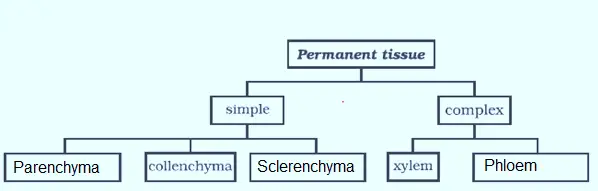
Permanent tissues:

  • A permanent tissue is a group of cells, which is derived from the meristematic tissues, but these cells have lost the power of division temporarily or permanently.
    Note: The development process by which cells which have been derived from meristematic tissue, take up a permanent shape, size and function is called differentiation.

Permanent tissues are of two types: –

  1. simple permanent tissue and
  2. complex permanent tissue

Simple permanent tissues:

These tissues are composed of cells which are structurally and functionally similar. These tissues are of three types:

  1. parenchyma
  2. collenchymas and
  3. sclerenchyma

Parenchyma:

Parenchyma tissue.
  • Derived from Greek word “para= besides & enchein= to pour”.
  • Parenchyma forms the bulk of plant body. It consists of thin walled living cells.
  • The cells are isodiametric, i.e., equally expanded on all sides.
  • The cell wall is thin and encloses a dense cytoplasm which contains a small nucleus and a large central vacuole.
  • The intercellular spaces are abundant.
  • The parenchyma is present in all the organs of the plants, i.e., roots, stems, leaves, flowers, fruit and seeds.

Types of Parenchyma:-

1) Storage parenchyma:- These parenchymous cells enlarge to store nutrients and water.

2) Aerenchyma:- These cells consist of large air cavities which store gases and provide buoyancy to aquatic plants.

3) Chlorenchyma:- These cells contain chloroplasts to perform photosynthesis. Eg mesophyll of leaves.

4) Prosenchyma:- Type of Parenchyma where cells are elongated.

5) Medullary Parenchyma:- Found radially arranged in between the vascular bundles in the stem . Meant for storage of reserve food.

6) Conjunctive Parenchyma:- Occurs in the root and meant for storage of water.

7) Armed Parenchyma:- Found in epidermis of leaves of some gymnosperms. The cells have many spiny projections which provide defence to the plant.

Function of Parenchyma

  • The main function of parenchymatous tissue is storage of food, e.g., starch in the parenchyma of cortex of potato tuber.
  • Parenchyma forms the framework of all the plant organs and tissues like cortex. Pith etc.
  • Parenchyma serves as packing tissue to fill the spaces between other tissues.
  • It stores waste materials of plants such as gum, crystals etc.
  • The intercellular air spaces of parenchyma cells allow gaseous exchange.
  • If chloroplast is present, the parenchyma tissue is called chlorenchyma and it performs photosynthesis.
  • In aquatic plants, large air cavities are present in parenchyma to give buoyancy to the plants to help them float. Such a parenchyma type is called aerenchyma.

For doubts and queries feel free to contact the writer on 9906890777.

The writer is working as a teacher and is currently posted at Central High School Pulwama.

Rouf Bhat’s Biology Notes.

Rouf Bhat CHS Pulwama

Class 9th.

CHAPTER NAME:- TISSUES

What are tissues.

Marie François Xavier bichat discovered tissue in between 1771–1802. He was a French anatomist and pathologist and he was also known as ‘father of histology’ . The term ’tissue’ was coined by N.Grew.

The English word “tissue” is derived from the French word “tissu”, meaning that something that is “woven”, from the verb tisser, “to weave”.

A group of cells similar in structure that work together to perform a particular function forms a tissue.
All types of tissues have two basic components:

  1. Cells: having common origin and function.
  2. Inter-cellular substances: Are nonliving, fibrous, jelly-like substances.

Importance of tissues

  1. Formation of tissues has brought about division of labour in multicellular organisms.
  2. Tissues become organized to form organs and organs into organ systems.
  3. Workload of individual cell ahs decreased due to origin of tissues.
  4. As a result of improved organization and higher efficiency, multicellular organisms have higher survival.

Classification of tissues

Tissues are broadly classified as

  1. animal tissues and
  2. plant tissues.

Plant Tissues

Plant tissues can be broadly divided into two main types. These are

  1. Meristematic tissue and
  2. Permanent tissue.

Meristematic Tissues:

  • A meristematic tissue constitutes a group of actively dividing cells present in the growing region of plant, e.g., the tips of roots and stems.
  • These tissues are responsible for increasing the length and girth of the plant.

Characteristics of meristematic tissues:

  • The cells of the meristematic tissue are similar in structure and have thin cellulose cell walls.
  • The cells may be spherical, oval, polygonal or rectangular in shape.
  • The cells of tissue are compactly arranged and do not have intercellular space.
  • The cells have dense protoplasm with prominent nuclei.
  • Vacuoles in these cells are either small or absent.

On the basis of origin meristematic tissues are divided into:

1) Primary meristem or Promeristem.

2) Secondary meristem.

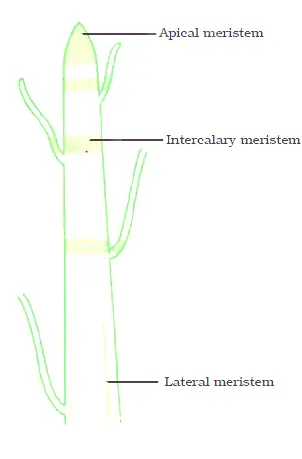
On the basis of their position in the plant body, meristematic tissues are classified into three types: –

  1. Apical
  2. Lateral
  3. Intercalary
Apical meristems:
  • These are present at the tips of roots, shoots, branches and leaves.
  • It brings about the elongation of the root and stem. It results in increase in the hight of the plant, which is called primary growth.
Lateral meristems:
  • These are present along the lateral side of the stems and roots. For example: cork cambium.
  • It causes the organ (stem or root) to increase in diameter and girth. This is called secondary growth.
Intercalary meristems:
  • They are located at the base of leaves or internodes, e.g., stems of grasses and other monocots and below the nodes (e.g., mint).
  • It produces an increase of length of organ such as leaves and internodes.
Chapter Notes: Tissues - Class 9 Science (Plant tissues)
Diagram showing three types of meristematic tussues

Functions of Meristematic tissue

  • Meristematic tissue acts as a parent tissue from which other tissues develop.
  • These tissues take part in growth by formation of new cells.
  • The place of injury in plants is healed up by the formation of new cells by meristems.

For doubts and queries feel free to contact the writer on 9906890777.